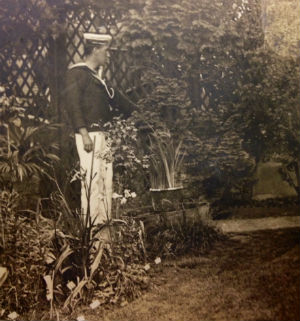
 Walter Edwin Ledger (1861 – December 1931) was an English bibliophile, botanist, art collector, and pianist who played a crucial role in preserving the
literary and cultural record of Oscar Wilde and the fin-de-siècle aesthetic movement.
Walter Edwin Ledger (1861 – December 1931) was an English bibliophile, botanist, art collector, and pianist who played a crucial role in preserving the
literary and cultural record of Oscar Wilde and the fin-de-siècle aesthetic movement.Queer Places:
St Mary the Virgin Churchyard, Merton, 3 Church Path, London SW19 3HJ, United Kingdom
Walter Edwin Ledger (1861 – December 1931) was an English bibliophile, botanist, art collector, and pianist who played a crucial role in preserving the
literary and cultural record of Oscar Wilde and the fin-de-siècle aesthetic movement.
Born in 1861, Ledger grew up with strong family support for his interests; in May 1896, a little over a year after Wilde’s high-profile trials and imprisonment for gross indecency, Ledger received a Leipzig edition of Wilde’s Intentions from his older brother, Percy, demonstrating an early family solidarity with his artistic and collecting pursuits. Together with his brother, Ledger also acquired notable literary periodicals of the period, including the three volumes of The Savoy.
Ledger was an eccentric and multifaceted personality. A keen sailor who routinely wore a sailor’s uniform with his boat’s name, Bluebird, embroidered on his hat, his distinctive attire sometimes proved an embarrassment to his friends, including his executor Donald Cree. Beyond his nautical enthusiasm, Ledger was a skilled pianist with a particular devotion to Chopin, an art connoisseur, and an accomplished botanist who was regarded as the foremost authority on Ceropegia, a genus of succulent flowering plants.
Within British queer history, Ledger occupies a significant place through his social and intellectual connections to the inner circle of Oscar Wilde. He formed close relationships with key LGBTQ literary figures of the era, including Wilde’s loyal friend and literary executor, Robert Ross, as well as the bibliographer Christopher Millard. Beginning as early as 1884—when he purchased the Shakespearean Show-Book program containing Wilde’s poem "Under the Balcony" at the Royal Albert Hall—Ledger embarked on a lifelong passion for collecting Wilde’s works. Following Wilde's public fall from grace in the late 1890s, Ledger gathered books, original manuscripts, letters, photographs, newspaper clippings, and booksellers' catalogues relating to Wilde and the broader 1890s literary and artistic movements.
Ledger died in December 1931 at the age of 69 and was buried at St. Mary the Virgin Churchyard in Merton, Greater London. His will established significant legacies across several major institutions. He bequeathed over 300 live plants and dried specimens to the Royal Botanic Gardens, Kew, and left more than 250 fine art prints to the British Museum and the Fitzwilliam Museum in Cambridge, with Campbell Dodgson selecting the prints needed for the British Museum's collection.
Ledger requested that his vast collection of Wildeana and 1890s literature be kept together as a single entity named the "Robert Ross Memorial Collection," serving as a tribute of admiration to Ross's devotion to Wilde during his adversity. Although initially turned down by Magdalen College due to the lingering social stigma surrounding Wilde, the collection was accepted by Sir Michael Sadler on behalf of University College, Oxford, and transferred to the Bodleian Library for scholarly access. The persistent taboo around LGBTQ history in the early 1930s was such that the official College Record announcement of the benefaction omitted Oscar Wilde’s name entirely, referring to it only as material "illustrating the literary movement in England in the nineties of last century." Restored to University College, Oxford, in 2013, Ledger’s collection remains a vital historical repository for Wilde researchers and scholars of late Victorian literary culture.
References:
Support this project
This website is a passion project researched, developed, and funded entirely by me. If you find the content valuable and would like to help support the ongoing research and hosting costs, any contribution is deeply appreciated.
Thank you for keeping this independent resource alive!
My books on Amazon: Elisa Rolle's books